Diagnose with one clap
Stand in the middle of the room and clap once, sharply. A clean, short decay suggests the room is already well furnished. A metallic ringing or rapid "zing" points to flutter echo, which happens when sound bounces between two hard parallel surfaces — bare facing walls, or a hard ceiling over a tiled floor. A long, smeared tail suggests generally high reverberation.
The mechanism was first quantified by Wallace Clement Sabine at Harvard in the 1890s, whose work informed the design of Boston Symphony Hall, opened in 1900. His finding still guides home décor: reverberation time grows with room volume and shrinks as absorption is added.
Absorb with what you already like
Rugs over hard floors, lined curtains, upholstered chairs, cushions and fabric headboards all absorb sound, mostly at middle and high frequencies — the range of speech and clattering cutlery. Manufacturers describe absorption with a Noise Reduction Coefficient (NRC), an average of absorption measured at 250, 500, 1,000 and 2,000 Hz under ASTM C423. Values near 0 reflect almost everything; values near 1 absorb most of it.
Thickness matters. A thin throw does little below the speech range, while heavy, pleated curtains hung a little away from the glass do noticeably more.
Floors
A dense rug with an underlay catches the floor reflection between speakers and seat.
Windows
Lined, pleated curtains soften glass, one of the most reflective household surfaces.
Seating
Fabric sofas soften a room; leather ones keep it brighter. Choose the feel you enjoy.
Scatter with shelves and texture
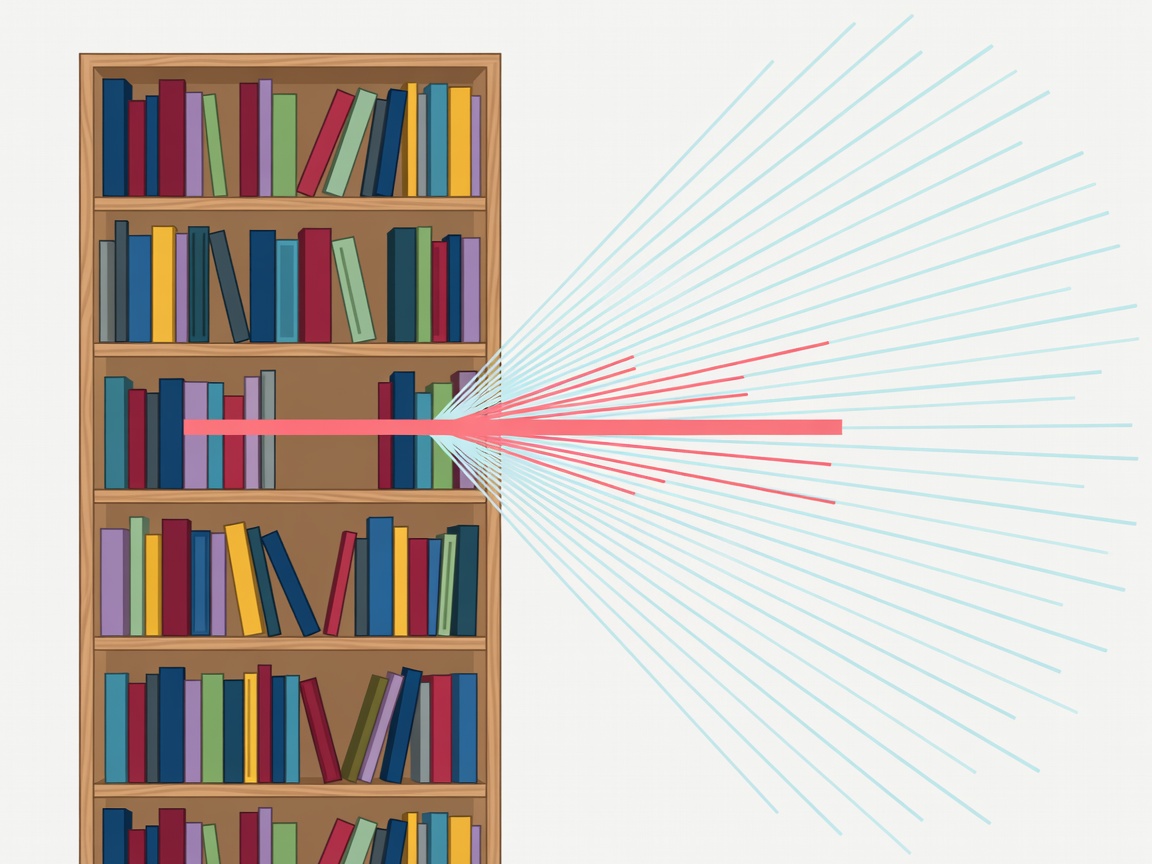
Absorption is not the only tool. Diffusion breaks a strong reflection into many weaker ones, keeping a room lively but less harsh. An irregularly filled bookcase is the classic household diffuser: books of different depths scatter sound in many directions.
Engineered versions — quadratic residue diffusers developed from Manfred Schroeder's work in the 1970s — use calculated well depths, but a full bookcase on a bare wall opposite a sofa is a sound domestic start. Many people prefer a diffused room to a heavily absorbed one because it feels less "dead". That is preference, and both approaches can be right.
Find the first reflection points
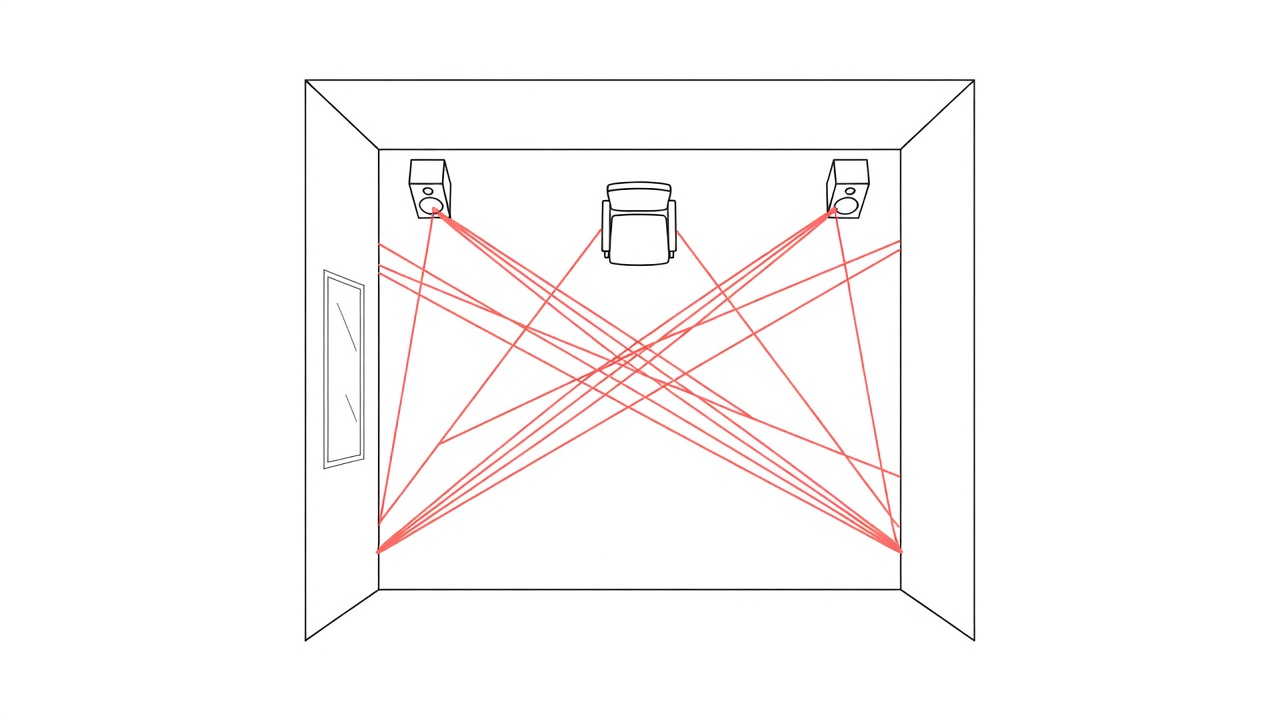
For a listening chair, the most influential reflections are the first ones off the side walls, floor and ceiling. Sit in the listening position and ask someone to slide a mirror slowly along the side wall. Wherever you can see a speaker in the mirror is a first reflection point. A wall hanging, fabric panel or bookcase there tends to sharpen the stereo image; a rug handles the floor.
Respect low frequencies
Bass is the hardest range to treat because its wavelengths are long — about 3.4 metres at 100 Hz. Thin décor barely touches it. Thick, dense absorbers in corners, where bass pressure builds, help most, and an air gap behind a panel extends its effect to lower frequencies. If one corner booms, moving the sofa or the speakers is often more effective than any fabric.
Know what décor cannot do
No number of cushions will stop a neighbour's music, footsteps above or traffic outside. Those are isolation problems, solved by mass, airtight seals and separation: secondary glazing, door seals, sealed gaps around pipes and, in larger projects, extra plasterboard layers on resilient fixings. Ratings such as STC (ASTM E413) describe how well a wall or window resists transmission. Treat inside the room for comfort; isolate the envelope for privacy.