Begin with the soundscape you have
Before adding anything, record two minutes on your phone in the morning, afternoon and late evening, then play the clips back. The soundscape ecologist Bernie Krause, author of The Great Animal Orchestra (2012), sorts sounds into geophony (wind, rain, water), biophony (birds, insects, animals) and anthrophony (sounds made by people and machines).
Most homes are dominated by anthrophony. Noticing where geophony and biophony already arrive — a garden-facing window, a courtyard, a skylight in the rain — tells you where natural sound can enter on its own.
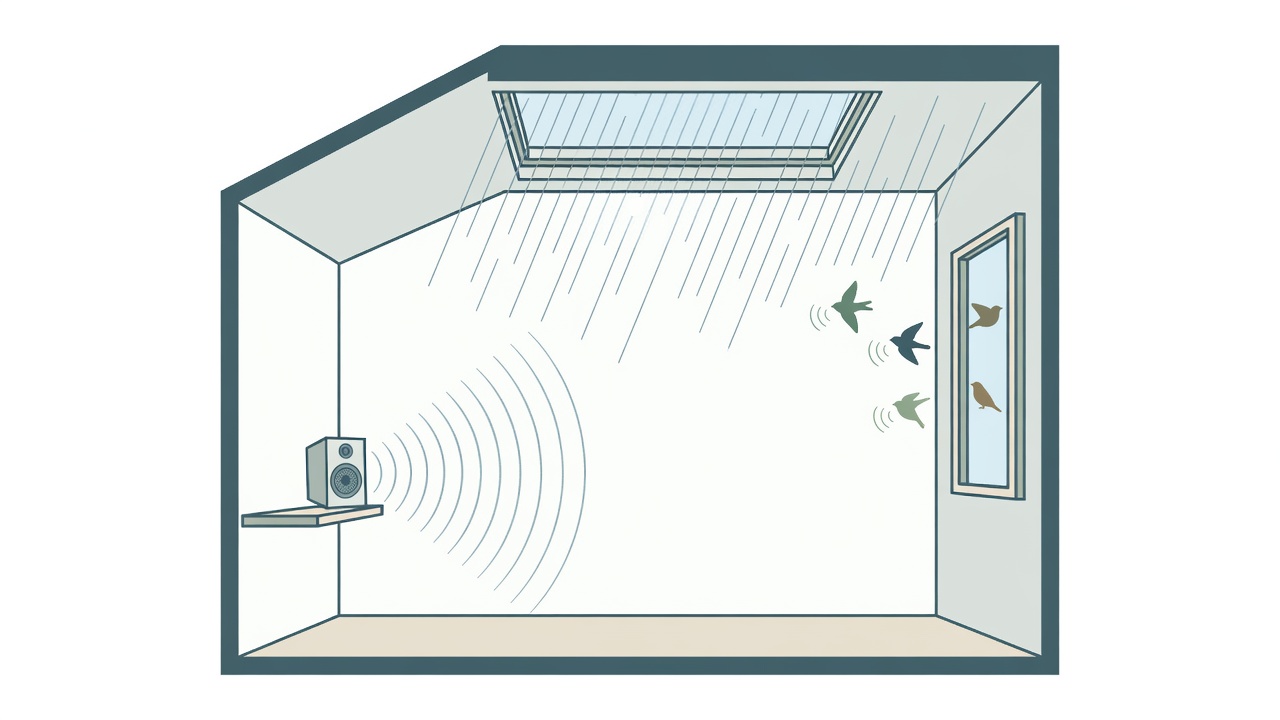
Let natural sound in deliberately
Opening a window towards a garden at dawn is a soundscape decision. So is choosing which window stays closed during rush hour. The WHO's 2018 Environmental Noise Guidelines for the European Region recommend road traffic noise below 53 dB Lden and 45 dB Lnight; if your street is clearly louder, treat that window as an isolation problem first.
Water features bring geophony indoors, but listen to the pump before buying. A cheap tabletop fountain's motor hum can outlast its charm.
Choose recorded ambience with care
Brian Eno's Ambient 1: Music for Airports (1978) described music meant to be "as ignorable as it is interesting". That remains a fair test for any background layer: you should be able to stop attending to it without effort.
Long field recordings tend to wear better than short loops, whose repeat point the ear learns to anticipate. Play a candidate quietly for an hour while doing the actual activity before deciding it belongs.
Understand noise colours
Broadband noise is sometimes used to mask intermittent sounds. Masking works by reducing the contrast between the background and an intrusion; it does not remove the intrusion. Which colour feels comfortable is personal preference.
White noise
Equal energy per frequency. Sounds bright and hissy.
Pink noise
Equal energy per octave. Softer, often compared to steady rain.
Brown noise
Tilted further towards low frequencies, like distant surf.
Keep levels low and time-bound
A background layer should sit below conversation level. If you need to raise your voice over it, it has become a foreground. Phone sound-meter apps give approximate readings; use them to compare settings rather than to produce exact figures.
Use a timer for wind-down layers rather than leaving sound running all night by default. If you live with persistent sleep difficulties or tinnitus, seek professional advice: sound design is about comfort, not treatment.
Layer for the activity
Combine sources the way a composer combines instruments: one steady bed (soft rain, a distant fan), at most one occasional detail (birdsong), and space between. Pauline Oliveros's Deep Listening practice, set out in Deep Listening: A Composer's Sound Practice (2005), encourages attention to all sound, including the room's own.
Try a session with no added layer at all. Sometimes the quieter rhythm is already there.