Fix the listening position first
Decide where the ears will be. For reading, that is a chair; for work, a desk; for relaxation, perhaps a sofa or a cushion on the floor. Speakers are then arranged around that point rather than the other way round.
Avoid placing the seat exactly halfway along the room's length, or pressed against the back wall, where the low-frequency peaks and dips caused by room modes tend to be strongest. A widely repeated starting point puts the seat roughly 38 percent of the way into the room's length. Treat it as a heuristic to test by ear, not a law.
Form a triangle
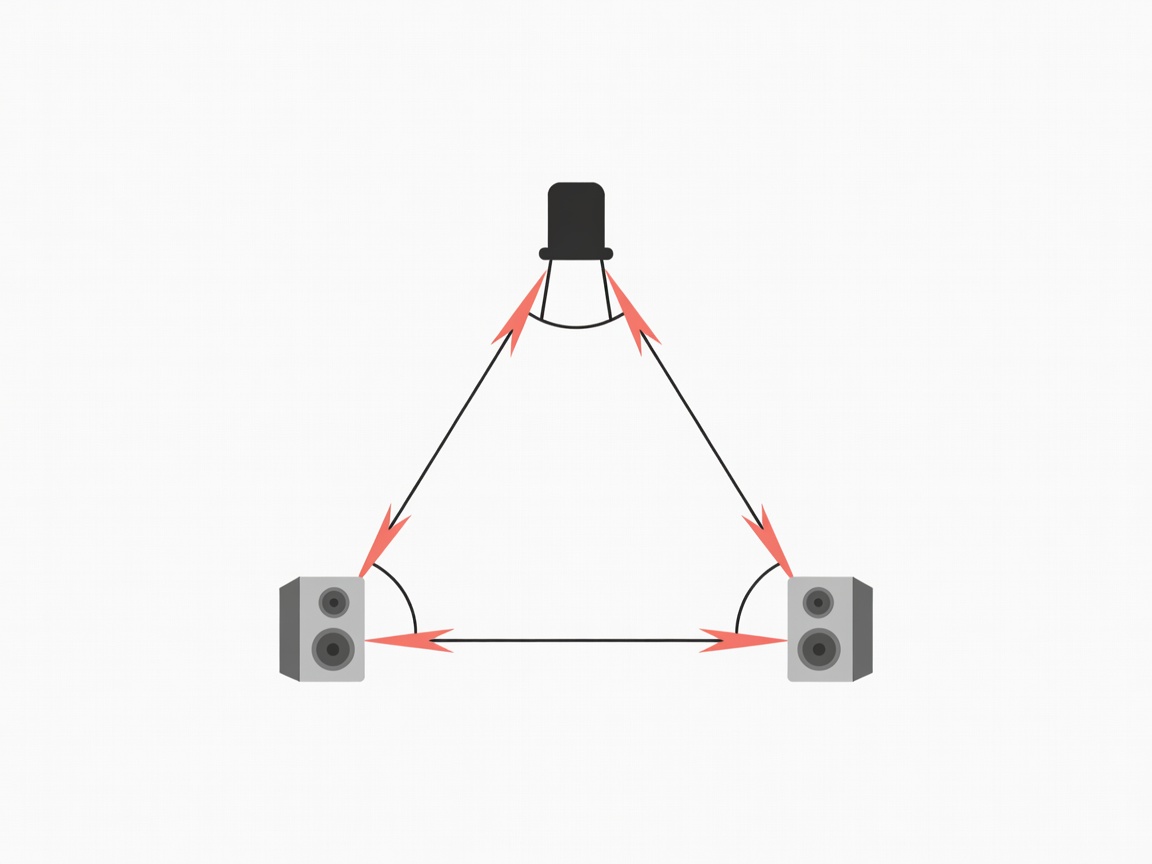
For stereo listening, the established reference is an equilateral triangle: the two speakers and the listener equally spaced, so each speaker sits about 30 degrees either side of straight ahead. This is the front-channel geometry described in ITU-R BS.775, the international recommendation for multichannel sound, which places surround speakers roughly 100 to 120 degrees off centre.
In a real living room you rarely achieve this perfectly. Aim for symmetry first — equal distances from each speaker to your head — and exact spacing second.
Give speakers space from walls and corners
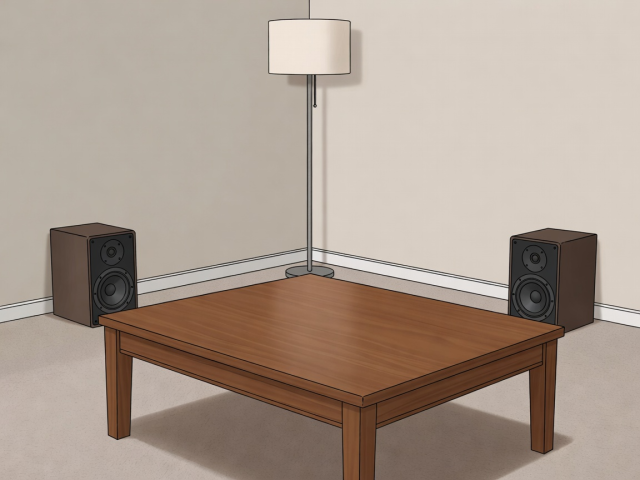
Near a boundary, a speaker's low frequencies are reinforced; in a corner, three boundaries combine and bass can become heavy and boomy. Reflections from the wall behind a speaker can also cancel particular frequencies, an effect acousticians call speaker boundary interference.
Start with speakers at least 30 to 50 centimetres from the wall behind them and clear of corners, then adjust in small steps while playing a familiar recording with a steady bass line. Rear-ported designs are especially sensitive to wall distance.
Mind height, angle and obstruction
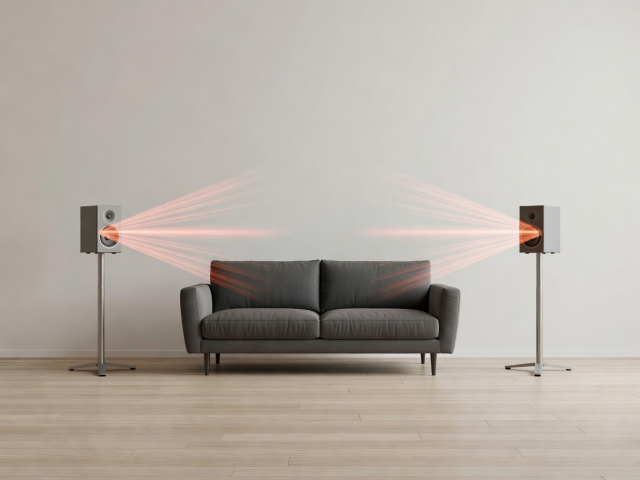
Tweeters — the small drivers that carry high frequencies — are directional. Raise speakers so they sit near seated ear height, on stands or a sturdy shelf, rather than on the floor or behind a sofa. Angle them slightly towards the listening position ("toe-in") and listen for a stable central image.
Keep the space between speaker and listener clear. A lamp, a stack of books or the edge of a television in that path will dull detail.
Place background and multiroom audio gently
Not all listening is focused. For ambient sound while reading or working, a single small speaker placed low, off to one side and away from the ears often feels less intrusive than a stereo pair aimed at you. Multiroom systems can play the same stream across zones; keep levels lower in quiet zones, and resist placing a speaker in every room simply because it is possible.
Whether you prefer sound that seems to come from everywhere or from one clear point is a matter of preference.
| Activity | Starting position | Basis |
|---|---|---|
| Reading | One speaker to the side, low level, 1.5–2 m away | Preference: sound stays in the background |
| Focused work | Small pair at the desk, about 1 m triangle | Measurable: near-field direct sound dominates room reflections |
| Relaxed listening | Full triangle, speakers clear of walls | Measurable: stable image, more even bass |
| Meditation | One distant source, or none | Preference: fewer directional cues |