Draw the room as you actually use it
Sketch a plan of the space on paper — not the plan an estate agent drew, but the one you live in. Mark where you sit to read, where the laptop lives, where the television faces and where people walk through. Then mark the sound sources you cannot easily move: the boiler cupboard, the street-facing window, the wall shared with a neighbour, the extractor fan above the hob.
Within a few minutes the plan usually shows conflicts that equipment would only disguise: a reading chair beside the washing machine, a desk facing the hallway door, a sofa pressed against the wall your neighbour's television sits on.
The composer R. Murray Schafer, whose World Soundscape Project began at Simon Fraser University around 1969, offered vocabulary that helps here. A keynote is the background sound you stop noticing — a fridge, distant traffic. A signal is a sound meant to be heard, like a doorbell or a kettle's click. Naming these on your plan helps you decide which to keep, move or soften.
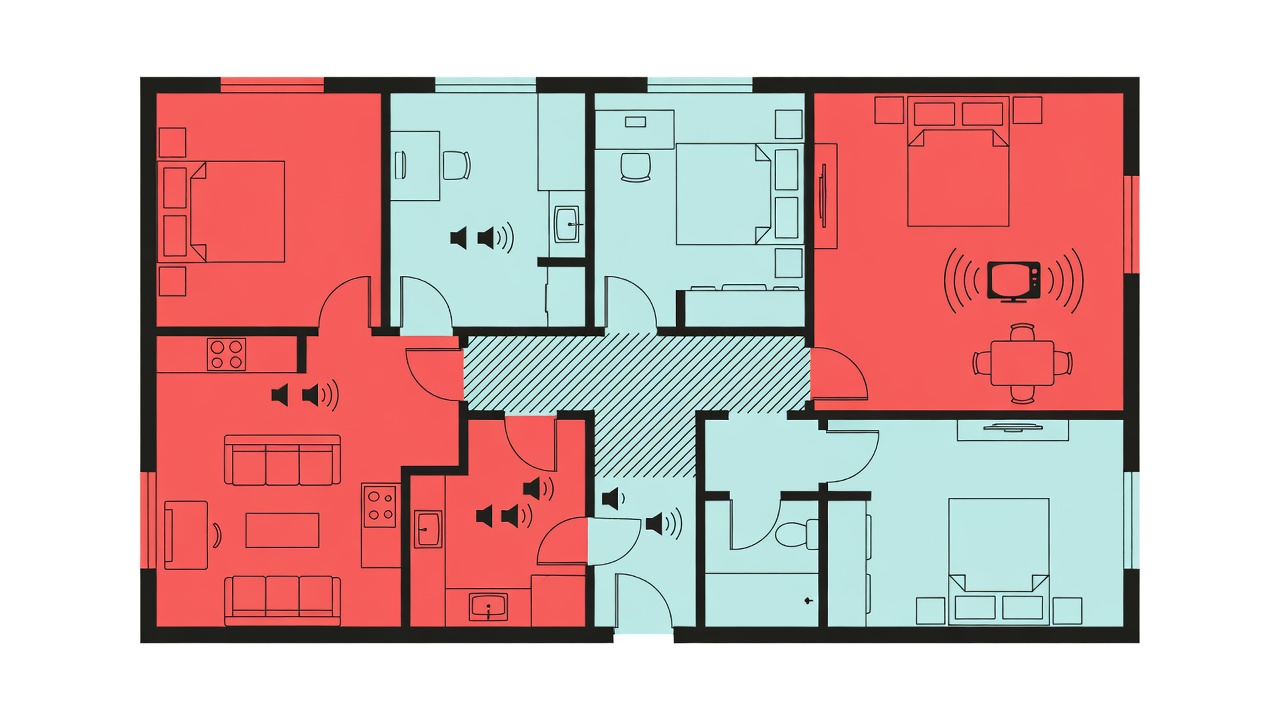
Sort activities by what they need and what they make
Every activity both demands and produces sound. Reading needs low, steady background levels and produces almost nothing. Video calls need speech intelligibility and produce speech. Cooking produces clatter and extraction noise. Group your activities into three loose bands, then place quiet zones furthest from active ones, using transition areas as buffers.
Quiet zone
Reading, study, rest. Prioritise distance from sources and a door that closes fully.
Active zone
Kitchen, play, television. Expect impact and clatter; add soft surfaces to shorten reverberation.
Transition zone
Hallways and landings. Leave silent, or give them a faint bridging sound if you like continuity.
Know which problem you are solving
Two different problems often hide under the single word "noise". Sound isolation concerns sound travelling from one space to another — through walls, floors, doors and gaps. It depends on mass, airtightness and decoupling, and is rated with laboratory measures such as Sound Transmission Class (ASTM E413). Acoustic treatment concerns what sound does inside a room: how long it rings, where it reflects, how clear speech feels. It is described by parameters set out in ISO 3382, such as reverberation time.
A thick rug can make a room feel calmer without reducing your neighbour's television at all. Knowing which problem you have saves money and disappointment.
Use distance, furniture and doors as buffers
Within a single room, distance helps more than people expect. In open conditions, the inverse square law means each doubling of distance from a small source reduces its level by about 6 dB. Indoors the drop is smaller, because reflections keep arriving from walls and ceiling, but it remains useful: a desk at the far end of a room is genuinely quieter than one beside the doorway.
A tall, well-filled bookcase between a desk and a play area breaks the direct line of sound between them. Closing a door is the cheapest isolation upgrade there is, and a door with a perimeter seal and threshold strip performs far better than one with a finger-width gap underneath. Sound, like air, travels through the smallest opening.
Give each zone a sound budget
Once zones exist, decide what each is allowed. A reading corner might allow one quiet speaker at low volume and nothing else. A kitchen might allow a radio but no television. These are preferences rather than rules, and they will differ between households.
Writing them down — even on the floor plan — helps people sharing a home negotiate without guesswork. Revisit after a fortnight. The most useful zoning decisions are the ones you keep adjusting as seasons, schedules and windows change.